Samples

Designed to Last, Built to Matter: Rethinking Our Carbon Footprint, Part 1
Editor’s Note: This post is part one of a two-part series focused on the carbon footprint of Amish-made furniture and DutchCrafters’ business practices as we celebrate Earth Month and continuously reflect on our core value of sustainability.
Black is the New Green: The Case for ‘Slow Furniture’
When I say that “black is the new green,” I’m referring specifically to the Amish, and I mean it literally. The “black” of the traditional Amish lifestyle, such as horse drawn buggies and off-grid shops, is already the most sustainable path we have. While the world chases high-tech environmental solutions, the “black” of the traditional Amish lifestyle, such as horse drawn buggies and off-grid shops, is already the most sustainable path we have. It isn’t about following a trend. It’s about a traditional way of life that happens to be the most sustainable path to help preserve our planet for the next generations. I have kids and grandkids, after all.
This commitment to doing things the right way, rather than the fast way, is exactly why I advocate for “slow furniture.” Just as slow food is better for individuals and communities than fast food, I believe that slow furniture is a far better choice than fast furniture – mass produced pieces designed for the moment, made from materials like particleboard, and destined for a landfill in just a few years. The real environmental leverage comes from the useful life of the product, and in the case of our Amish-made furniture, it starts at the very beginning of the supply chain.
The Raw Materials and Stewards of the Earth
Unlike much imported furniture, most hardwoods used in the production of Amish furniture come from sustainably managed forests in the United States and Canada. This matters for two reasons:
- Sustainably managed forests act as significant carbon sinks, absorbing more CO2 from the atmosphere than they release.
- Those forests are near the same regions where the furniture is made minimizing the impact of transportation emissions from the raw materials that will be transformed into Amish-made dining tables, beds, sofas, and more.
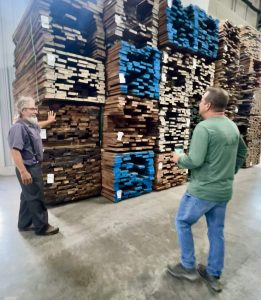
The Amish believe in stewardship of the earth and care for all God’s creation. While they are not likely to use terms like “ecologically friendly” or “sustainable,” their way of life is built on these principles. Whether or not sourcing is certified, the supply chain starts with sustainably managed forests.
A few of our Amish suppliers are actively involved in the sourcing and distribution of these woods. For example, one has a separate business that distributes hardwoods. Another family owns several hundred acres of forest in Kentucky, and they personally harvest much of the wood themselves.
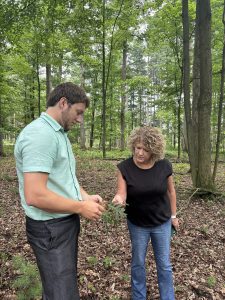
This conscientious approach to stewardship provides the raw materials for a product built with integrity that stands up to the rigors of time. A few years ago, I performed an experiment in our Sarasota showroom to illustrate the difference between these high-quality raw materials and processed alternatives found in fast furniture.
The Chainsaw Test
It was during a staff meeting. I brought out a cheap cabinet made of particleboard that had been purchased three years prior in an emergency. It was buckling, bubbling, warping, and generally falling apart. I produced a chainsaw and cut it in half. It flew apart like potato chips, making a general mess, because particleboard is essentially compressed scraps and glue, with no natural grain to hold it together.
Contrast that with the decade-old solid wood bench I sawed into next. It produced pure sawdust. That piece would have lasted a century or more, without a doubt. Something unheard of in today’s disposable mindset.
When consumers buy furniture built for the long haul, they are maximizing the useful life of the raw materials. That longevity does more than just save you money or keep a piece out a landfill. It actually turns your home into a frontline for environmental protection. By keeping real wood furniture for, let’s say, fifty years instead of five, and ensuring it doesn’t end up burned or discarded, you are physically creating a carbon vault.
The Carbon Sink Inside Your Home
This is where the science meets our mission. Just as sustainably managed forests are carbon sinks, the solid wood furniture made from forest trees is one too, acting as a vault where carbon is stored rather than released.
A good rule of thumb is that wood is approximately 50% carbon by weight. To put that in perspective, every pound of carbon stored in your furniture represents nearly four pounds of CO2 that was removed from our atmosphere.
- The Science: Trees absorb CO2 from the atmosphere. That carbon remains stored within the wood until it either rots or is burned.
- The Comparison: Contrast this to logs used in a firepit, which release that carbon back into the atmosphere immediately.
- The Result: By choosing solid wood and keeping it for generations, the carbon remains vaulted.
The Bottom Line
Black is the new green. The simplicity, off-grid, old-fashioned dimensions of the Amish lifestyle embody slow furniture. Just as slow food is healthier for the consumer, community and planet than fast food, slow furniture is healthier than fast furniture. Amish-made furniture is good for consumers, communities, and the Earth.
Next week: In part two this two-part series, Jim takes you behind the scenes of our business operations to discuss how we’ve lowered our carbon footprint, and where we can improve.

This post was originally published on July 25th, 2013. It was updated on January 30th, 2025. If you have spoken Read more
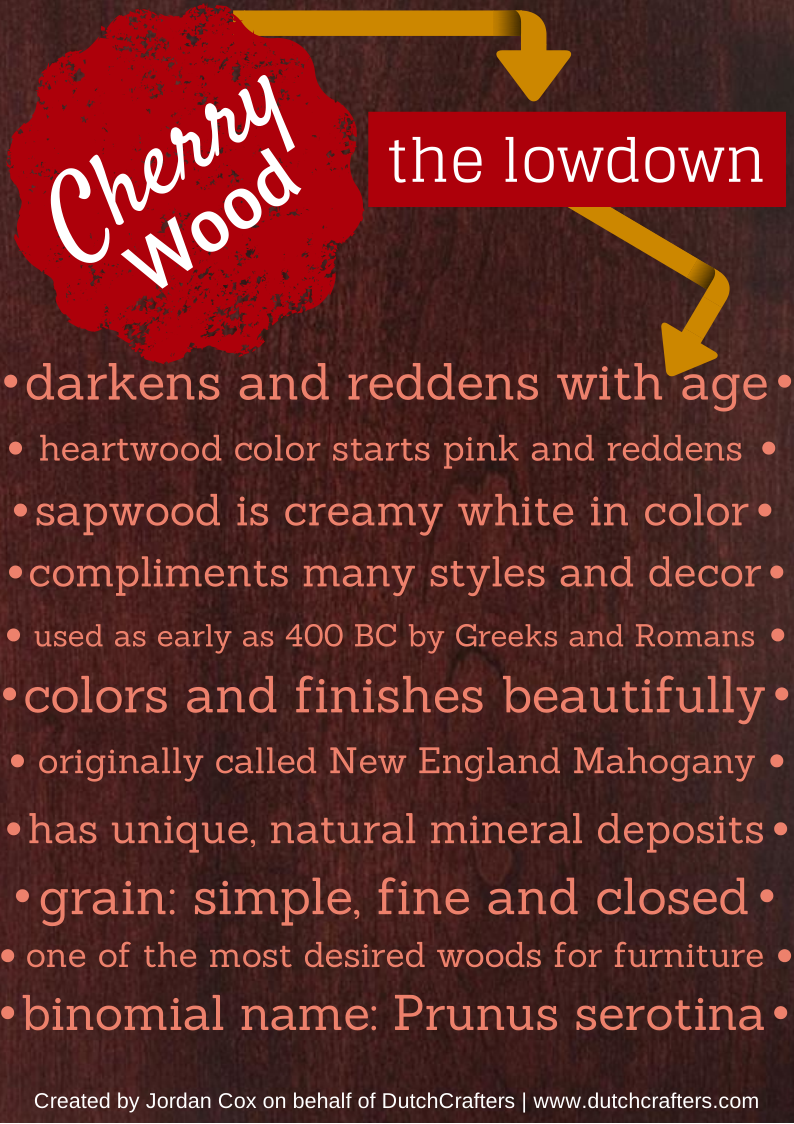
You Put Cherries On Top For A Reason! Why cherry wood? There are so many wood choices, is there really Read more

In which I use far too many italics, and redefine "pudding." I just plain do not understand how this is Read more

This blog post was updated on December 28, 2018 with new entryway table designs. It (almost) goes without saying: Your Read more