Samples
Designed to Last, Built to Matter: Rethinking Our Carbon Footprint, Part 2
Editor’s Note: This is Part 2 of a two-part series on the carbon footprint of Amish-made furniture and DutchCrafters’ business practices. You can read Part 1 at Designed to Last, Built to Matter: Rethinking Our Carbon Footprint, Part 1.
I want to offer a big dose of humility up front.
At DutchCrafters, we are far from perfect. There is so much more we could do, and sometimes we don’t even get the little things right. I cringe just a little when I see all the plastic water bottles we serve at company events and in our showrooms. That’s on my to-do list, along with a hundred other things we could do better.
I happen to be an entrepreneur who values the Triple Bottom Line of People, Profits, and Planet. For a variety of reasons, I care deeply about our ecological impact. Where possible, I want to use our leverage and example to help preserve our planet for the next generations.
With those confessions out of the way, here is an honest account of what we’ve done, where we’ve fallen short, and what we’re working toward.
The Biggest Negative: Domestic Freight
Domestic freight is perhaps one of the biggest negative ecological impacts we make. Shipping heavy, solid wood furniture all over the United States takes energy, and there is no way to move durable furniture from a woodshop in Indiana to a home in California without a carbon cost.
What I can say is this, almost all of our furniture goes directly from our warehouse to the end customer: No retail distribution centers, no extra stops in between, and the furniture waiting at the other end of that trip is built to last. When you consider the carbon cost of a single delivery spread over decades of use, the picture looks very different than the same trip made for furniture that ends up in a landfill in 10 years.
The Things We Can Control
1. Packaging
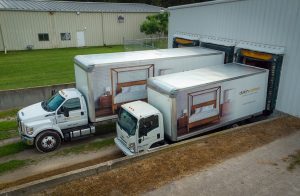
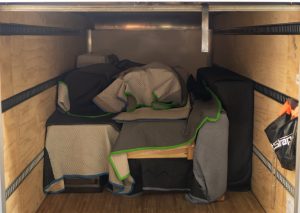
The vast majority of our furniture is delivered blanket-wrapped by our own fleet of trucks and protected by sturdy, reusable moving blankets. This is more customer-friendly, better protects the furniture, and is a major ecological benefit. We avoid a great deal of packaging material that would otherwise end up as waste.
Most imported furniture requires significant amounts of cardboard, plastic, and Styrofoam to survive transit. At DutchCrafters, we skip almost all of that. It’s one of the clearest wins we have as a company.
2. Solar Panels
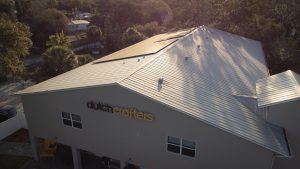
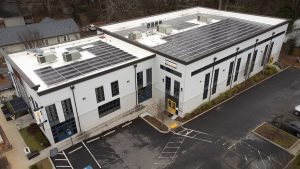
We’ve installed solar panels at our Sarasota, Florida headquarters and Showroom and at our Alpharetta, Georgia Showroom. It doesn’t eliminate our energy footprint, but it moves us in the right direction.
3. Working from Home
We also allow the majority of our employees to work from home with a hybrid schedule. Fewer daily commutes mean lower emissions from our own staff and a better quality of life for our people. That’s the Triple Bottom Line in practice. It is a decision that’s good for our people and good for the planet at the same time.
4. Planting Trees
We donate to American Forests to plant a tree for every order a customer places at DutchCrafters. You can watch the count grow in real time on our website. We’ve surpassed 42,000 trees as of this writing, and the number continues to climb with every order. Planting trees isn’t a substitute for reducing emissions at the source, but every tree planted is one that will be absorbing carbon for decades to come.
The Bottom Line
We are still learning how to be the best possible bridge between traditional Amish craftsmanship and modern commerce. That bridge has costs, and I’ve tried to name them honestly here.
What I keep coming back to is slow furniture. Just as slow food is healthier for the consumer, community, and planet than fast food, slow furniture is healthier than fast furniture. We believe in furniture built to last, made from sustainably sourced wood, by people who have practiced stewardship of the land for generations. That is a better choice for the planet than the alternative, even accounting for everything I’ve acknowledged in this post.
We may never find the perfect balance between People, Profits, and Planet, but we will continue to work on it for future generations.
This post was originally published on July 25th, 2013. It was updated on January 30th, 2025. If you have spoken Read more
You Put Cherries On Top For A Reason! Why cherry wood? There are so many wood choices, is there really Read more
In which I use far too many italics, and redefine "pudding." I just plain do not understand how this is Read more

This blog post was updated on December 28, 2018 with new entryway table designs. It (almost) goes without saying: Your Read more